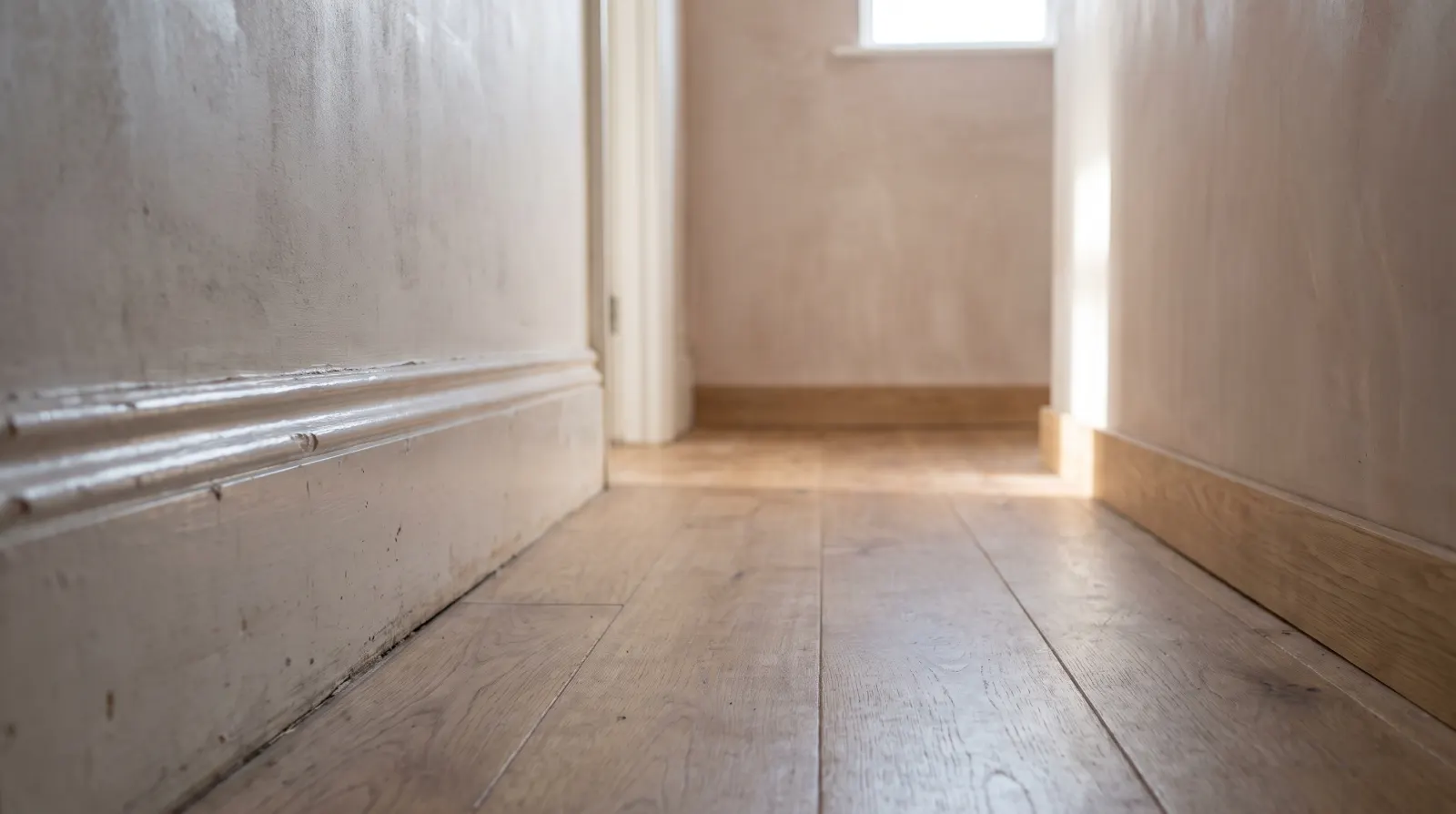
The short answer: decide where the old board ends before you order the new. Take a cut end of the old skirting, match the measured section rather than the catalogue name, stop at a door lining or a corner, and sand the paint back at the joint. If nothing on the shelf matches, a cutter can be ground to your section, delivered in 5–7 working days.
Why doesn't extension skirting match the original?
You can stand at the doorway between the old house and the extension and see it at once: the old board is a little deeper, a little softer in its curves, and a slightly different white. Nothing is wrong with either. The old board has been painted many times, so every crisp edge has rounded over and the face has thickened. The new board is raw timber that has not had a century of gloss.
On top of that, profile names are not a standard. One merchant's “ogee” is another's “Victorian”, and a lot of stock boards are simplified versions of the period shape. Matching by name gets you something similar. Matching by the measured section gets you the same thing.
Where should the old skirting stop and the new start?
Choose the break before the plasterers leave, because it decides everything else. The best places are the ones the eye already expects a change:
- A door lining or architrave. The skirting finishes against the architrave on both sides, so a change of board on either side reads as ordinary.
- An internal corner. A mitre or a butt in a corner is hidden by the corner itself.
- A change of floor finish. Where carpet becomes tile or oak, a change in the board's bottom edge looks deliberate.
The one place to avoid is the middle of a plain wall. If you have to join there, do it on a long angle (a scarf joint) rather than a square butt, and let the paint cover the seam.
How do you match the profile?
- Find a cut end of the old board. The best place is where the original house was opened for the extension: a board end at the new doorway, a piece taken off for the steel, or a length inside a built-in cupboard. A hand-width piece (about 100mm) is enough.
- Trace it or post it. Draw round the end on our A4 trace sheet with a loyalty or gift card beside it for scale and photograph it from straight above, or post the offcut. A photo of the front face cannot give you the section.
- Allow for paint. Read the section where the paint is thinnest, and expect the new board to be a fraction thinner than the old one at the joint.
The longer version is in how to match an old skirting board.
How do you finish the joint so it disappears?
- Match the height, then scribe the bottom. Old and new floors sit at slightly different levels. Cut to the height of the old board at the joint and scribe the bottom edge to each floor rather than trusting the stock height.
- Sand the old paint back at the joint. Otherwise you get a fine step where the thicker old board meets the new one, which light will find.
- Prime every cut end before it goes on the wall, including the end against the old board.
- Caulk, then paint both boards together. Painting the new and old in one coat across the joint hides most of what is left.
Old paint can contain lead. If the original board has not been tested, do not dry sand it; use a test kit first and wet-sand or use a chemical stripper if it is positive.
Questions
Why doesn't new skirting match the old skirting in my extension?
Three things: the old board carries decades of paint that adds thickness and softens the detail, the profile names between suppliers are not a standard, and old and new floors rarely sit at exactly the same level. Match the measured section, not the name.
Where should the old skirting stop and the new begin?
At a natural break: a door lining, a corner or a change of floor. A joint in the middle of a plain wall is the one people see.
Can I get new skirting made to match the old?
Yes. From a cut end of the old board we either name a cutter we already hold or grind a new one to your section, delivered in 5–7 working days.
Next: more from the blog · Matching mouldings across a whole-building renovation